Susan Tsivitse Arthur
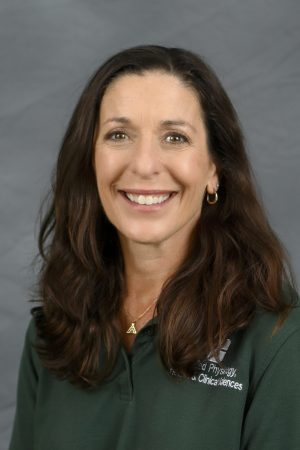
Susan Tsivitse Arthur
Research Interest:
PI of Molecular Exercise Myology Lab (MEM Lab). Studying the signals that regulate skeletal muscle repair in age and disease.
Teaching Specialty:
Undergraduate: Exercise Physiology (EXER 3280) Exercise Testing (EXER 3286); Exercise Prescription (EXER 4286) Graduate: Skeletal Muscle in Health and Disease (KNES 6282), Research Methods (KNES 6160), Nutrition (KNES 6260), Cardiopulmonary and Metabolic Diseases Exercise Prescription (KNES 6134), Advances in Clinical Exercise Physiology (KNES 6120)
Education:
Ph.D. Applied Physiology, University of Toledo, Toledo, OH (2003) M.S. Exercise Science,
University of Toledo, Toledo, OH (2001) B.S. Biology, University of Toledo, Toledo, OH (1995)
Personal Interests:
Personal Interests: Shutzhund working dog sport, farming, resistance training, auxilliary member at VFW #5305, former family support coordinator for the U.S. Air Force 118th Air Support Operations Squadron
COS Profile:
https://pivot.proquest.com/profiles/C9E2A89BAC1BA5190143C04222C0CDB5
Research Statement:
The MEM Lab is dedicated to examining the orchestration of signaling pathways in regulating skeletal muscle plasticity (regenerative potential and protein synthesis) within various paradigms including aging and disease. We use molecular and cellular techniques on various in vivo and in vitro skeletal muscle models. We study how Notch, Wnt, and mTOR affect regenerative potential, protein synthesis, metabolism, inflammation, and force production within aged or diseased muscles exposed to physiological stimuli. Notch signaling is considered critical for the early stages of repair, while Wnt and mTOR regulate the later stages of muscle repair. Still, the interactions of these pathways are not known, especially following physiological stimuli, including exercise. Furthermore, the effect of Notch and muscle protein synthesis (regulated by mTOR pathway) has not been studied. The ultimate goal of the MEM lab is to use the discoveries of cellular regulations of skeletal muscle to be translated to clinical populations.
Current Projects:
- The effect of obesity and Notch inhibition on muscle repair and muscle protein synthesis. Obesity impairs the regenerative potential of skeletal muscle but the mechanisms are not known. Notch signaling, known to be important for muscle repair may be impacted by obesity but it is not known. We are currently examining the effect of obesity and Notch inhibition on muscle repair, muscle protein synthesis, and mTOR signaling.
- The effect of Breast Cancer and CAR T Cell Therapy on Contractile properties and Notch signaling. Cancer cachexia is defined as a significant unintentional weight loss accompanied by muscle atrophy (loss of skeletal muscle mass) and decreased muscle strength, with or without fat loss. At least 50% of cancer patients are diagnosed with cachexia which results in functional limitations, exacerbated cancer progression, and, ultimately, early mortality, with reports of 1/3 rd of cancer deaths attributed to cachexia. Cachexia impedes responsiveness to cancer therapy and may exacerbate tumor growth and metastasis. To our knowledge, there are no reports on the effect of Triple Negative Breast Cancer (TNBC) on muscle contractile properties. In addition, there are no studies on the effect of CAR T cell therapy on muscle properties. The purpose of this study is to determine the effect of TNBC and CAR T cell therapy on muscle function.
- The orchestration of Notch, Wnt, and mTOR during myogenesis in young and aged. Notch, Wnt, and mTOR are important for muscle repair but their interaction is not well understand. Notch is known to be important for early stages of myogenesis
but must be inhibited for the later stages. mTOR and Wnt may be upregulated during the later stages of muscle. Using cell culture models, we are studying the effect of manipulating these pathways during proliferation and differentiation/fusion of
myoblasts.
2015- current: Associate Professor, University of North Carolina at Charlotte, Charlotte, NC
2006 – 2015: Assistant Professor, University of North Carolina at Charlotte, Charlotte, NC
2003 – 2006: Post-doctoral fellowship, Department of Neurology and Neurological Sciences, Stanford University School of Medicine
Recent Publications:
GOOGLE Scholar
PubMed